
Daily notes
Your day. Your feelings.A few words are enough.
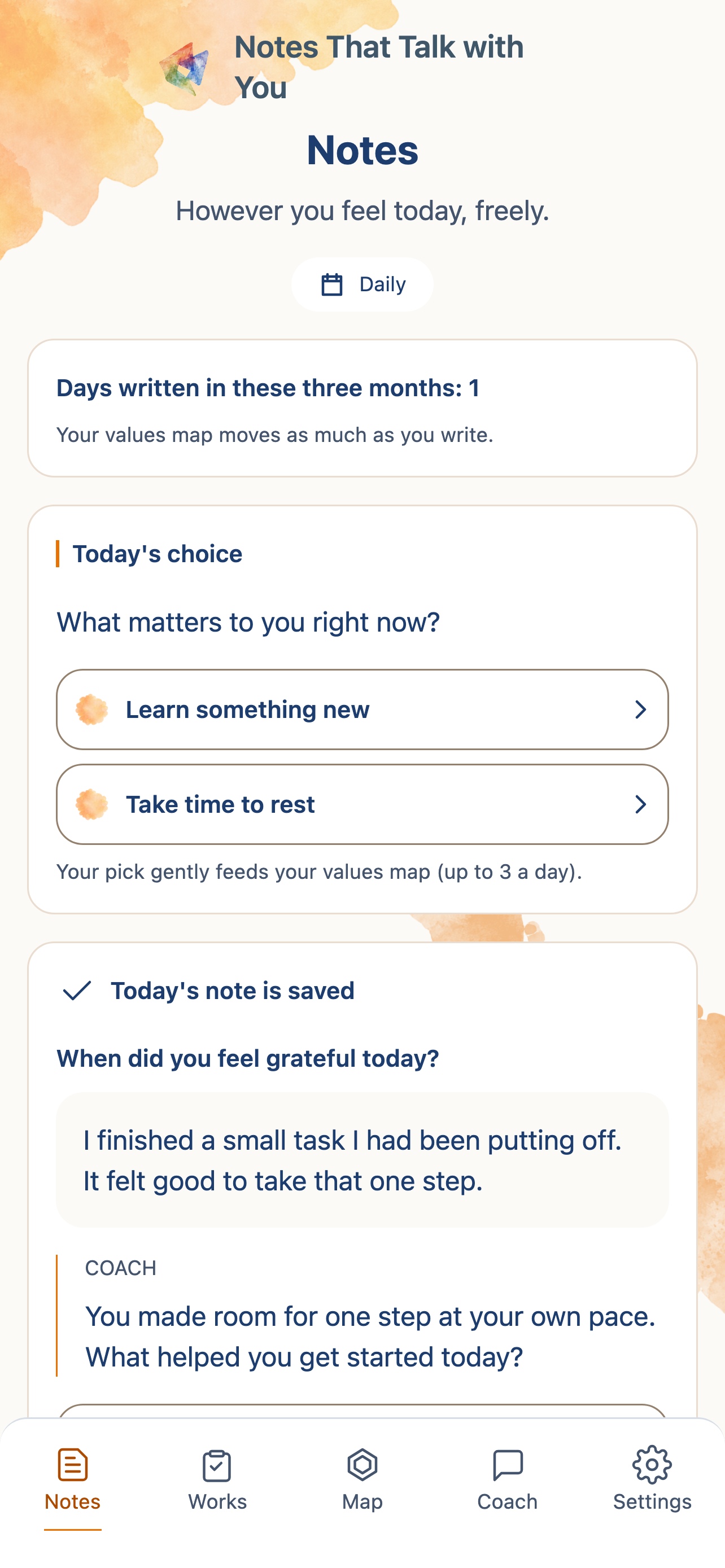
Begin with a daily prompt, or just a few words of your own. The choices you make and the words you save gradually add to your values map.

 Notes That Talk
It feels good to be understood. But you may still be wondering what to do next. Notes That Talk with You is an AI coach designed by a professional coach to help you work through what’s on your mind. It learns what matters to you from your notes, and helps you find your next step.


Free basic features. In-app purchases available.
When you see your values, you can choose your days.

From your notes to yourself. From yourself to your next step.
Write about your day and how you feel.
See what matters to you take shape.
Start wherever feels right today.
Little by little, find your own words for what comes next.
Begin with a daily prompt, or just a few words of your own. The choices you make and the words you save gradually add to your values map.
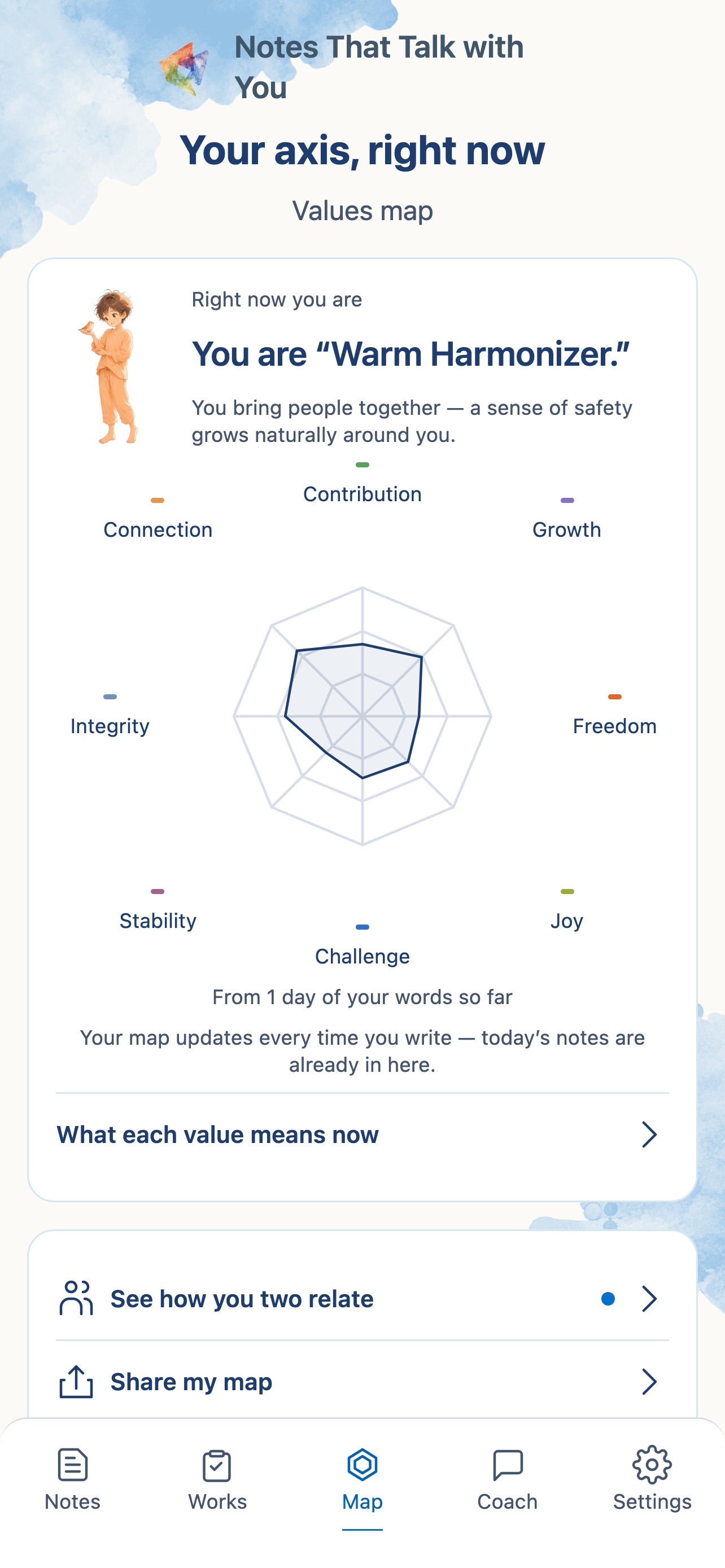
Your notes and answers help your values take shape. Use radar and bar charts to look back on how they change over time.
Drawing on Schwartz’s theory of basic human values, we organized our own eight axes and 16 types. They are a way to reflect, not a test of who is better or right.
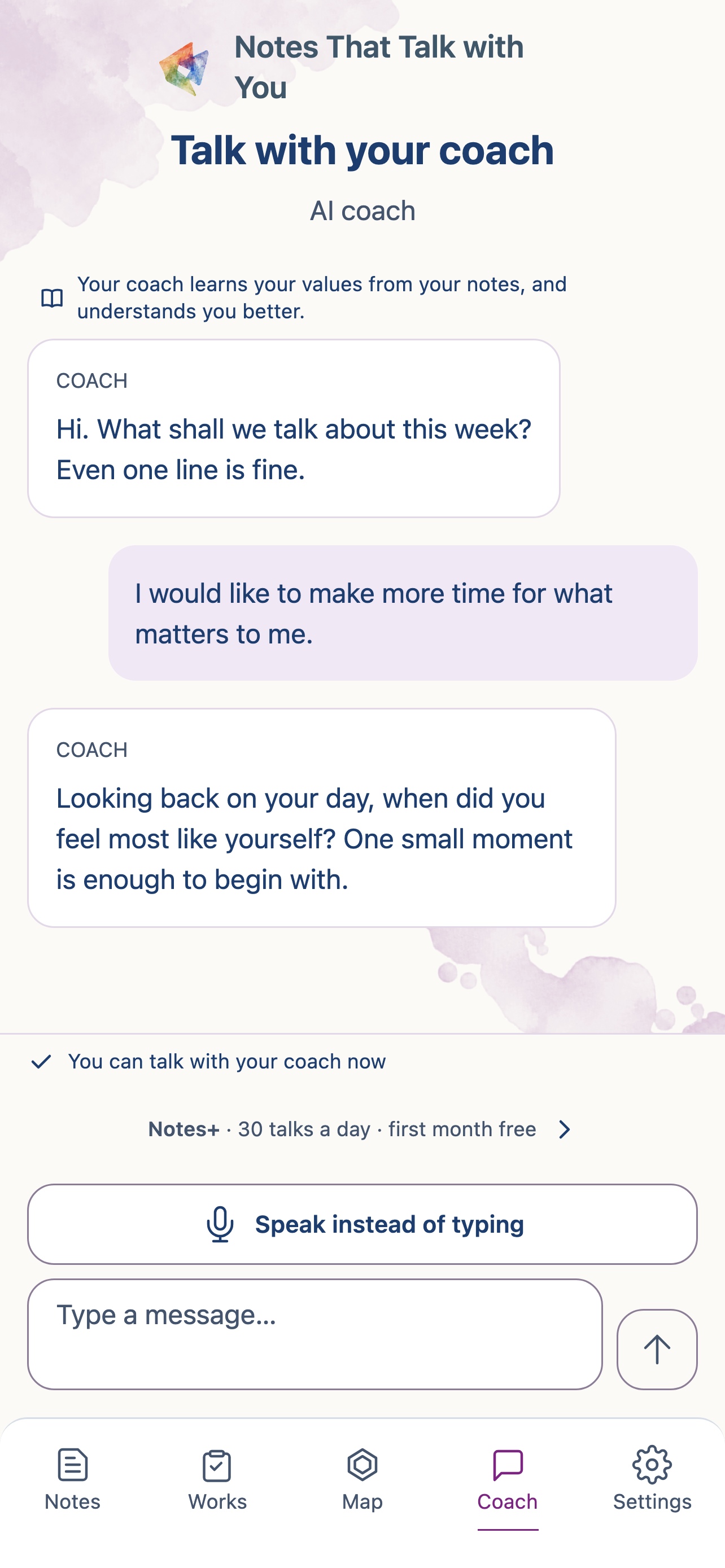
Your coach draws on your notes, values map, and past conversations to help you sort through what’s on your mind. Its questions give you room to notice your own answers.
Say what’s been hard to say. Anytime.

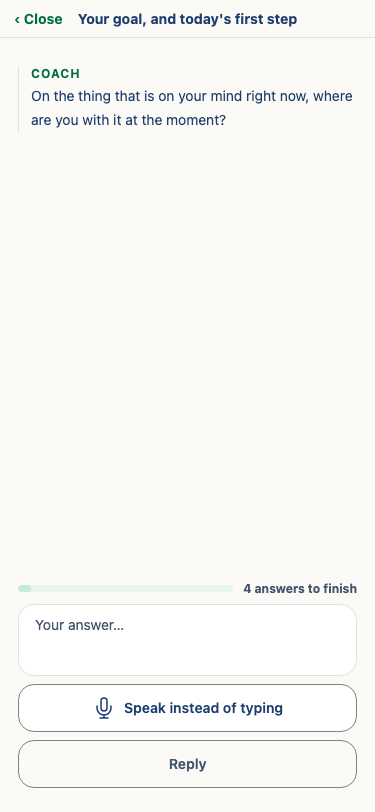
Put your thoughts and feelings into words with a question to guide you. Make a little room to notice what matters beneath your familiar answers.
This example shows a question within a guided work.
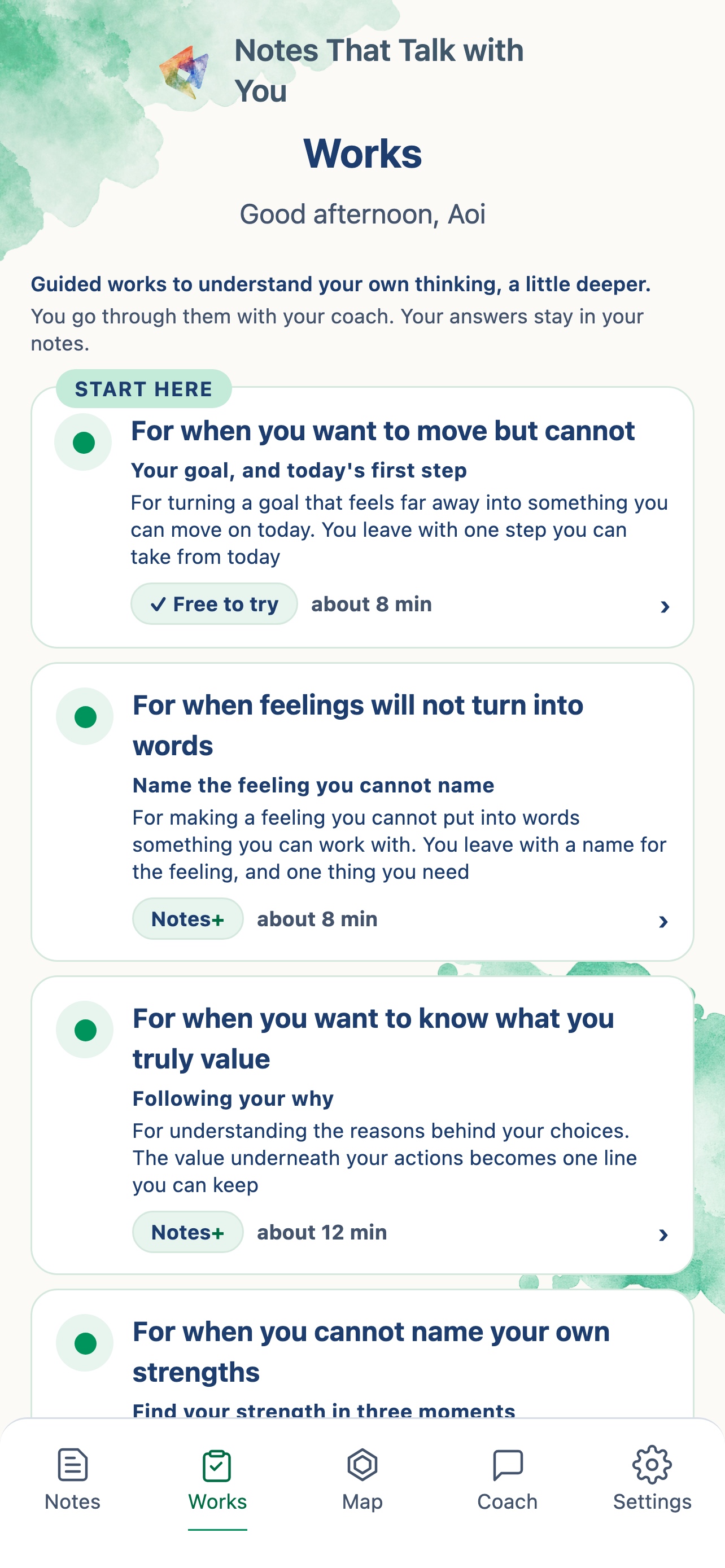
Explore a theme through a guided conversation at your own pace. Start with a suggestion from your AI coach, or choose a work from the library yourself.
Some works are free; others are available with Hanasu+.
Your types and values
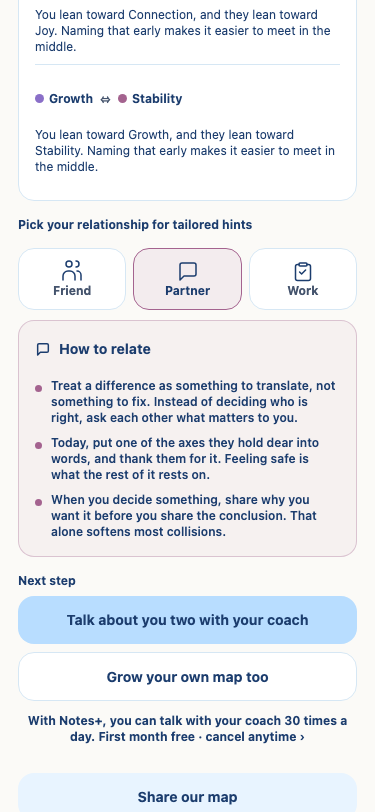
Hints for relating to each other
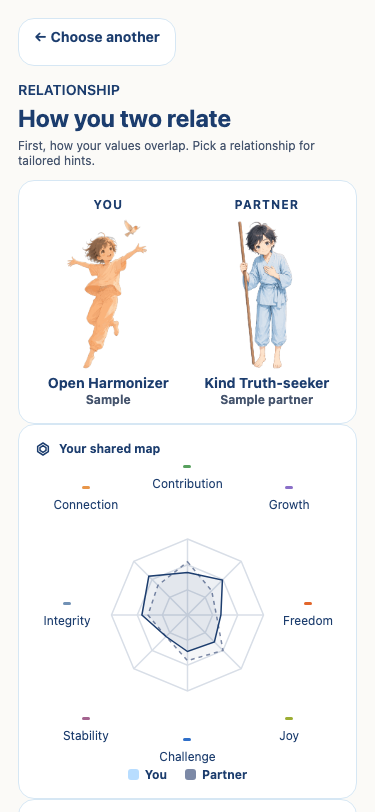
Compare your values map with a partner, friend, or colleague. Receive hints for relating to each other, based on what you each value and where you differ.
Only your value axes and type are shared. Your notes and conversations with your AI coach stay private from the other person.
Your notes, your values map, your AI coach.
Each helps you see a little more of yourself.
Feelings, values, and small discoveries.
Reflections that began with a note or a conversation.

I kept guessing how someone felt from their expression, then feeling upset. On a day when I gave myself some space, I felt less anxious. I decided I could pay attention to their words and actions, instead of my guesses.

I have always found it hard to sit with the thought that someone might dislike me. As I talked, I began to see a belief I had carried since childhood: that making anyone feel bad was wrong.

Whenever I learned something new, I compared myself with people who were better at it. Talking it through, I realized I wanted more moments when a customer felt satisfied. My reason for learning finally felt like my own.

I worried that telling my company what I wanted from work would sound selfish. As we talked, I found my own words for it: I want to learn, and I want to deepen my work. I felt ready to try saying that.

One day I wrote that I felt really good, and we looked at why. My thoughts were clearer, and I could see what I could do right now. From there, I could see a goal further ahead, too.

I said I did not know what would make me happy. I wondered if working within my comfort zone meant I was weak. Eventually, my own words came out: what matters now is how I want to be.

I had so many things I wanted to do, and I was trying to move them all forward at the same pace. Talking helped me decide where to start. Making that choice felt like a way of trusting myself.

I really like the habit of writing things down. Otherwise, I forget. Months later, I can look back and think: oh, that is what was on my mind then. I like being able to remember that.

Before work, I chose three things to write about that day: how I spent my time, the people I worked with, and my reflections. I started looking forward to both the work and the time to write afterward.

Growth is not only for people who are already good at something. With the right approach and environment, anyone can grow. I finally put into words that this is how I want to work with people. I was glad I had talked.
Swipe or use the arrows to read more.
Translated from the Japanese page. These anonymized summaries are based on actual conversations with the AI coach.

I had never really thought about my values. Answering the questions helped me notice how I see things right now. They were easy to understand, and getting to know myself felt surprisingly enjoyable.

It is when I am alone at night, more than during the day, that my thoughts get tangled. I am glad the AI coach is there to listen. It remembers what we talked about before, which feels reassuring.

I use it more as a journaling habit than a search for myself. As my entries build up, I can see myself with a little more distance. I have enjoyed it more than I expected.

I now have somewhere to put worries I could not tell anyone about. I had been carrying them with nowhere to let them out. Just having a place for them means a lot.

When things feel heavy, or I am suddenly unsure, I can gently put down a little of what I am carrying. That is what this app feels like to me.
Swipe or use the arrows to read more.
Translated from the Japanese page. These anonymized summaries draw on store reviews, in-app feedback, and messages shared with us.
Photos are illustrative and do not depict the people whose stories appear here.
Free basic features. In-app purchases available.
See the store and in-app purchase screen for Hanasu+ pricing and terms.

Start with a line about something that happened today, or a thought that stayed with you. You can also use the daily prompt to get started.
The eight value axes help you reflect on what matters to you right now. Values can shift with your situation and experiences. The map does not rank people or put your personality in a box.
You talk with your own AI coach. It draws on your notes and values to help you sort through your feelings and thoughts.
Basic features are free. For Hanasu+ pricing and terms, check the store and the in-app purchase screen. You can also read our Commercial Disclosure.
For information about how your records are stored, used, and shared, see our Privacy Policy. For the conditions of use, read our Terms of Use.
This app helps you reflect on your feelings and thoughts. It does not replace medical care or professional support. If you need diagnosis or treatment, please speak with a qualified professional.
Notes That Talk
with YouFree basic features · In-app purchases